The problemRobot learning has a touch-data problem
Robot manipulation policies are trained on teleoperation data. But the teleoperators
producing that data cannot feel what the robot feels. The result: demonstrations with
wrong force profiles, operators working at a fraction of normal speed, and models that
fail at the contact-rich tasks that matter — insertion, threading, snap-fit assembly,
in-hand manipulation.
Robot-side sensing is advancing rapidly. High-resolution tactile sensors now deliver
thousands of pixels per fingertip. But sensing without feedback is a camera without a
display: the information never reaches the human whose demonstrations shape the policy.
And there is no shared dataset that pairs robot encoder and torque readings with
ground-truth haptic expectation — the field has no ImageNet for touch.
As Ed Colgate put it in his 2026 IEEE Haptics Symposium keynote, dexterity is a
negotiation between the operator, the robot, and the environment. Today's
teleoperation stacks break that negotiation: hardware-in-the-middle introduces friction,
hysteresis, and latency; the back-channel from environment to operator is too weak to
convey what is actually happening at contact.
The visionA shared dataset. A generative model. An open benchmark.
We propose a large-scale, multi-institution effort to capture what the robot
should be feeling alongside encoder and torque readings across a standardized
suite of touch-heavy manipulation tasks — and to release the resulting data, model, and
benchmarks as a shared resource for the field.
Concretely: build capture rigs that minimize hardware-in-the-middle (in the spirit of
UMI and MIT Dexop), deploy them across partner labs, run operators through a common
benchmark battery, and record kinematics, torques, and ground-truth tactile state
simultaneously. Train a generative model that predicts expected tactile state from
kinematics — usable as a training signal, a reward shaper, or a source of synthetic
haptic supervision for future policies.
In practiceTouch-heavy manipulation, captured end-to-end
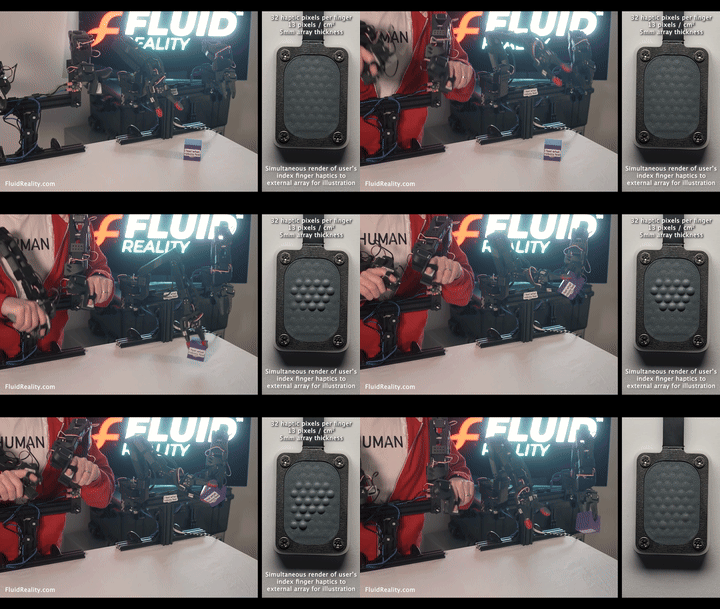
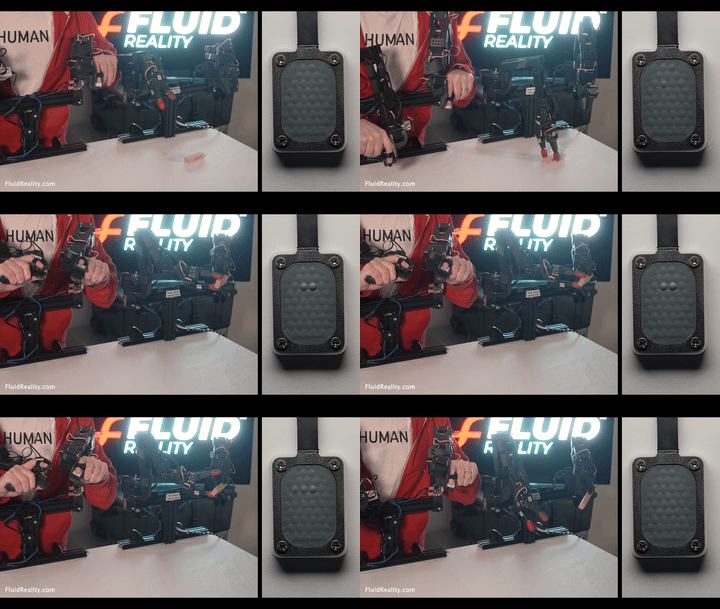
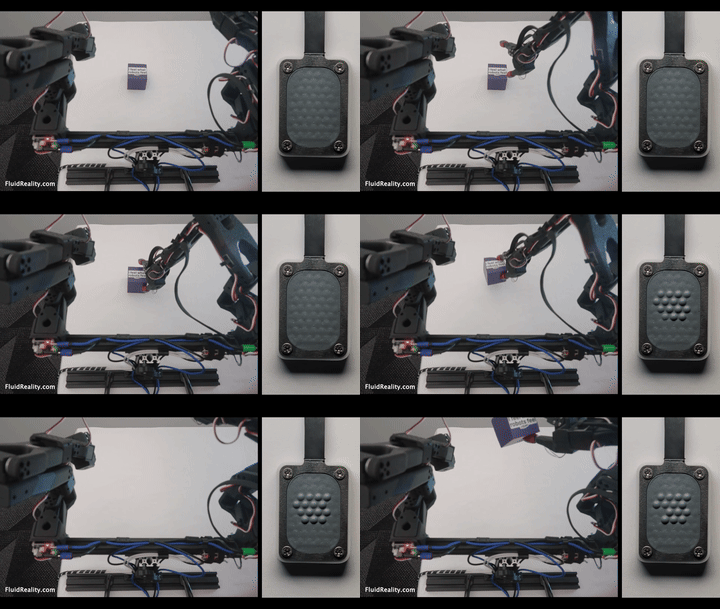
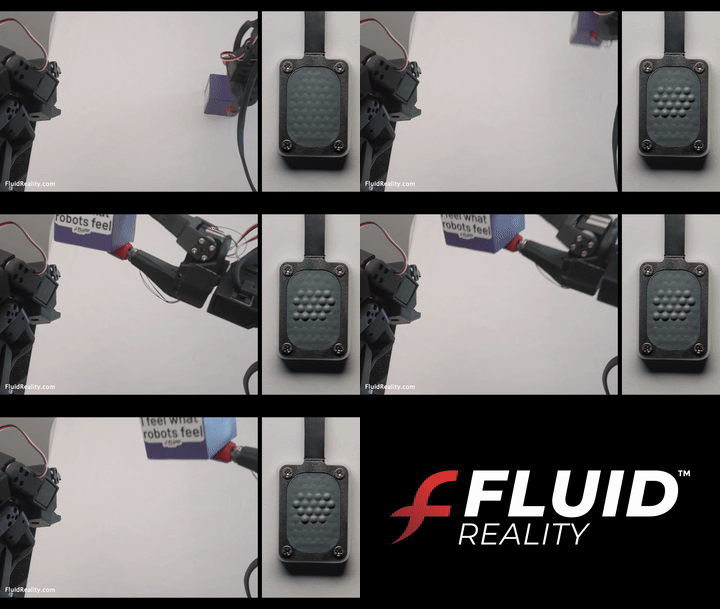
Early demonstrations from a prototype dual-arm teleoperation system show operators
performing contact-rich manipulation with real-time fingertip haptic feedback — the
kind of episodes the dataset would capture at scale.
Prototype teleoperation clips. Final dataset would span dozens of tasks across multiple labs.
HardwareThe capture rig
The capture rig combines high-resolution robot-side tactile sensing with operator-side
haptic feedback — so the operator feels what the robot feels in real time, and every
demonstration is annotated with ground-truth haptic state. Fluid Reality's
6 mm electroosmotic actuators contribute the operator feedback layer — 128 pressure
levels per actuator, <15 ms response, 1 kHz update rate that renders both contact
and vibration in a single silent micro-hydraulic element. Small enough to fit inside a
glove fingertip; no compressors, no pneumatics. Hugging Face contributes the data
infrastructure layer: dataset hosting, versioning, and distribution on the Hub, plus
model release alongside.
128
Pressure levels per actuator (7-bit)
< 15 ms
Pressure response (100 µm displacement)
1 kHz
Update rate — contact & vibration in one actuator
6 mm
Actuator diameter · solid-state micro-hydraulic